
Parker County heat, attic ductwork and metal buildings
Spray Foam Insulation in Weatherford, TX
Foam and blown-in insulation that keep Texas heat out of the house, the shop and the barn, priced space by space.
- Free on-site estimates in Parker, Hood and west Tarrant counties
- Written quote with foam type, thickness, R-value and price per space
- Roof, ductwork and moisture problems pointed out before we spray
Keeping the Heat Out in Parker County
Spray foam insulation in Weatherford is mostly about summer. NOAA climate figures published on Wikipedia show average daily highs of 94.6F in July and 94.7F in August, a typical yearly peak above 103F, and a record high of 116F. Most houses here sit on a slab with the air handler and ductwork up in the attic, where temperatures climb far above the outdoors on a July afternoon. As local spray foam insulation contractors, we keep that heat out, either by sealing and insulating the attic floor or by spraying foam on the underside of the roof so the ducts sit inside a cooler space, and we insulate the shops, barns and metal buildings that dot the county.
What Texas code asks for
Texas adopted the energy chapter (Chapter 11) of the 2015 International Residential Code as its standard for one- and two-family homes, effective September 1, 2016, according to the State Energy Conservation Office. Parker County, along with Tarrant, Hood, Palo Pinto, Johnson and Wise, is in Climate Zone 3. For Zone 3, the 2015 code's prescriptive table lists R-38 for ceilings, R-20 or R-13 plus R-5 continuous for wood-frame walls, and R-19 for floors over unconditioned space, per the Department of Energy's building science summary. For existing attics, ENERGY STAR's Zone 3 recommendation is R-49 when the attic is empty, or adding about R-38 over 3 to 4 inches of old insulation.
Attic floor or roof deck?
This is the main decision on most Weatherford homes. If the attic floor is open and the ductwork is in good shape, sealing the ceiling and blowing in cellulose or fiberglass to R-38 or more is the lower-cost route. If the air handler and long duct runs are up in the attic, spraying foam under the roof deck pulls them inside the insulated envelope, so they are not pushing cold air through ducts sitting in 130-degree air. Roof-deck foam costs more up front; HomeGuide lists it at $1,500 to $9,000 versus $1,100 to $6,800 for foam on the attic floor. We price both when both make sense.
Closed cell vs open cell in North Texas
Open-cell foam is the common choice for roof decks and walls in this climate. It is soft, expands a lot, seals air well and costs less per inch; HomeGuide rates it at about R-3.5 to R-3.7 per inch. Closed-cell foam is dense and rigid, about R-5 to R-7 per inch, and slows water vapor, which makes it the better pick for metal buildings, where it stops condensation on the steel, and for any spot that needs the most R-value in the least depth. Either way, foam left exposed in living spaces usually needs a thermal barrier; we tell you what the product listing requires.
Growth means newer homes, with their own gaps
Weatherford has grown fast. Point2Homes' ACS summary shows about 21.4% of the city's homes were built in the 2000s, 19% in the 2010s and 8.2% since 2020. Newer homes meet the code of their day, but bonus rooms, rooms over garages, knee walls and attic hatches are frequent problem spots, and a home with a two-story layout often has an upstairs that runs several degrees warmer than the downstairs. Air sealing and targeted foam fix most of it.
Shops, barns and barndominiums
Out on acreage around Weatherford, Springtown, Millsap and Aledo, metal buildings are everywhere: shops, barns, equipment storage and barndominiums. Bare steel turns into an oven in summer and sweats when humid air meets cool metal. Closed-cell foam sprayed onto the panels insulates and stops the condensation. Parker County's permitting department states that the county does not issue building permits in unincorporated areas, so the insulation spec is often up to you and your builder; we help set one that works.
Questions to ask any insulation company
When you call spray foam insulation companies or insulation contractors near you, ask each one the same things. Which foam goes where, how thick and to what R-value? Will they seal the attic floor or the roof deck, and why? How will they protect the ductwork and air handler? How long do you stay out after spraying (HomeGuide says at least 24 hours)? What happens to old insulation? Does the quote list each space separately? Our written quote covers all of it.
Spray foam insulation cost
HomeGuide's 2026 guide puts installed spray foam at $1.50 to $5.00 per square foot: $1.50 to $3.50 for open-cell and $3.00 to $5.00 for closed-cell. It lists a whole house at $8,000 to $20,000 and notes typical minimums of $1,000 to $2,000 or more. Fixr puts new-construction foam at $2.75 to $6.50 per square foot. Those national ranges help with budgeting; your price depends on the space, the foam, the thickness and access, and the number on our written estimate is what you pay.
Areas We Serve
We work in Weatherford and across Parker County: Hudson Oaks, Willow Park, Aledo and Annetta along the I-20 corridor toward Fort Worth, Springtown and Reno to the north, Azle on the Tarrant County line and Millsap to the west. We also serve Mineral Wells in Palo Pinto County, Granbury on the Brazos in Hood County, Cresson on the Hood-Johnson line and Benbrook on Fort Worth's southwest side. The housing ranges from new subdivisions with attic ductwork to older homes in Weatherford, Mineral Wells and Benbrook, and the acreage in between is full of shops, barns and barndominiums. Each town page covers what is different there.
- Spray Foam Insulation in Weatherford, TX
- Spray Foam Insulation in Hudson Oaks, TX
- Spray Foam Insulation in Willow Park, TX
- Spray Foam Insulation in Aledo, TX
- Spray Foam Insulation in Annetta, TX
- Spray Foam Insulation in Springtown, TX
- Spray Foam Insulation in Azle, TX
- Spray Foam Insulation in Mineral Wells, TX
- Spray Foam Insulation in Granbury, TX
- Spray Foam Insulation in Millsap, TX
- Spray Foam Insulation in Benbrook, TX
- Spray Foam Insulation in Reno, TX
- Spray Foam Insulation in Cresson, TX

Common Questions
How much does spray foam insulation cost in Weatherford?
HomeGuide's national range is $1.50 to $5.00 per square foot installed, with open-cell at the lower end and closed-cell at the higher end, and many installers have a $1,000 to $2,000 minimum. Foam on a roof deck runs about $1,500 to $9,000. We give you a written price after seeing the house, and that is what you pay.
Should I spray foam my roof deck or insulate the attic floor?
If your air handler and ducts are in the attic, roof-deck foam brings them inside the insulated space and usually makes the house easier to cool. If the attic is open and the ducts are in good shape, sealing the ceiling and blowing in insulation costs less. We price both when both are reasonable.
What R-value does Texas require for attics?
Texas follows the 2015 IRC energy chapter for one- and two-family homes, and the Zone 3 table lists R-38 for ceilings. For existing attics, ENERGY STAR suggests R-49 for an empty attic or adding about R-38 over existing insulation.
Is open cell or closed cell better for a Texas attic?
Open-cell is the usual choice for roof decks in this climate because it seals well and costs less per inch. Closed-cell is better for metal buildings and tight spaces where you need more R-value per inch.
Can spray foam stop condensation in a metal building?
Yes. Closed-cell foam bonded to the steel removes the cold surface where moisture condenses, and it insulates the building at the same time.
Do I need to leave during spraying?
Yes. HomeGuide advises staying out at least 24 hours after spray foam is applied. Blown-in insulation does not require that.
What We Insulate
Six services for Texas homes and buildings, each priced on its own line so you can choose what to do first.
Spray Foam Insulation
Open-cell and closed-cell foam for roof decks, walls and metal buildings, matched to the Texas heat.
Learn more →Attic Insulation & Air Sealing
Seal the ceiling, then bring the attic to R-38 or more, or move the insulation to the roof deck.
Learn more →Metal Building & Barndominium Insulation
Closed-cell foam on steel shops, barns and barndominiums, to stop condensation and hold the cooling.
Learn more →Blown-In Insulation
Cellulose or fiberglass blown into attics and closed walls, the cost-effective way to add R-value.
Learn more →Insulation Removal & Replacement
Out with damaged, wet or rodent-contaminated insulation, then sealing and new insulation.
Learn more →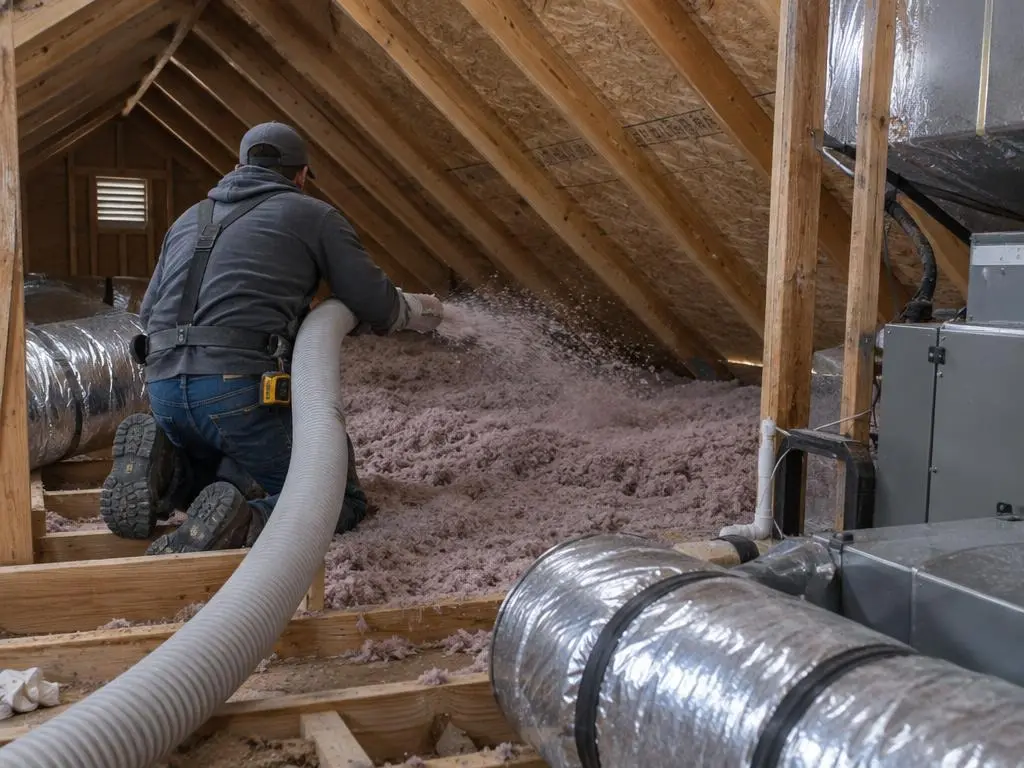
Why Homeowners Call Spray Foam Insulation Weatherford
Attic decisions explained
Attic floor or roof deck, open-cell or closed-cell: we price the options and explain the trade-offs for your ductwork and roof.
Metal building know-how
Closed-cell foam on steel for shops, barns and barndominiums, sized to how the building is used and cooled.
Problems found first
Roof leaks, crushed or leaky ducts, damaged insulation and wiring issues get flagged before anything is covered.
Every space in writing
Material, thickness, R-value and price per space, so bids are easy to compare.
Get a Spray Foam Insulation Estimate
We look at the attic, the walls or the building, explain your options and send a written price for each space.